
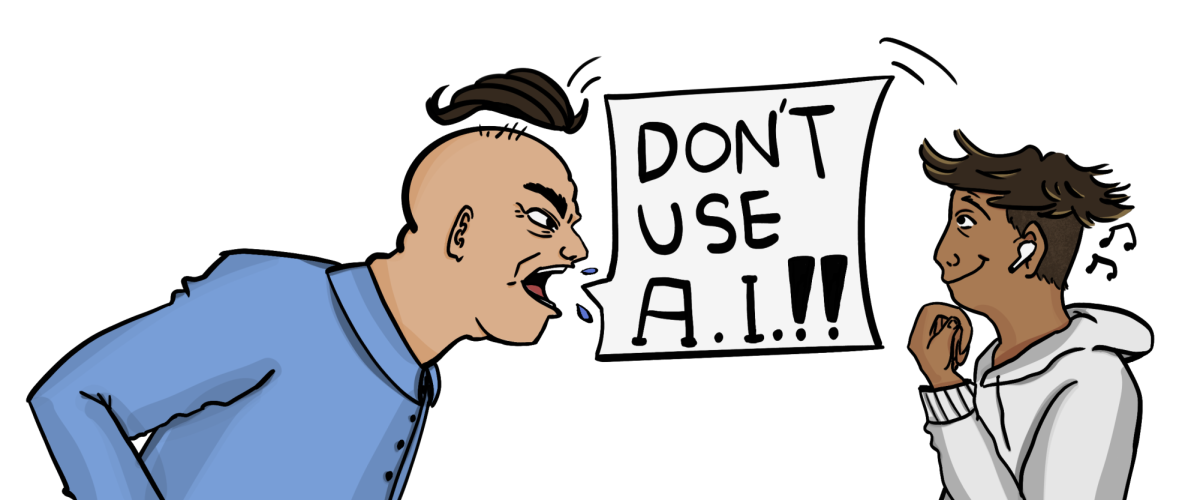
Currently, we are in a generative AI revolution. Like the French one, it’s complicated. In the past year, AI has infiltrated schools and changed the way students behave and learn. It’s become a tool of destruction; a cautionary tale teachers tell their students. However, the Patriot Press staff believes there’s a way we can allow AI to coexist and help us in the education system.
We all know the major problems with AI in schools: it makes cheating easier, it takes away student creativity, and, with AI evolving at the rapid rate it is right now, it’s just making students more dependent on it than ever before. AI is only going to get more advanced. It’s only going to corrupt more lessons at school and distract more teenagers.
With new inventions coming into the classrooms, teachers have always had to adapt. From chalkboards to whiteboards, or even paper documents to online ones, new technologies have seen resistance, but ultimately have been a way to advance education. With the rise of AI, teachers don’t seem to want to adapt. But is there a way we could?
The Patriot Press staff thinks we can, if we go about it right. AI is deemed uncontrollable, and for the most part, it is. It finds you on whatever website you’re on, and gives kids access to any answer they could want. Unbridled access to this tool is not good for kids because if there’s an easy opportunity to cheat, they’re going to take it! They’re learning to not think for themselves and instead rely on AI. But if we can find a way to regulate AI in our school, then we can use it to our advantage in our learning environment. To use AI in the best way possible, we need to first be willing to invite it instead of fighting it.
There are two main things students need to learn about AI: how to use it without abusing it, and realizing the power it holds and how it affects our environment. These two skills go hand in hand, because using AI unnecessarily is part of the downfall of our environment. It’s important to moderate our use so we can use this tool in the right way, while also having the least amount of effect on our environment.
The first skill is critical to learn. If students don’t know when to stop, we can’t use AI effectively. Since there’s no parameters on AI, we have to teach students to use self control. Some students might just ignore this and use AI freely anyway, but it’s better to have them know there is a better option when using AI, rather than avoiding the topic like the plague.
The second skill is equally as important. We have to realize that yes, AI is harmful, but it’s also not going anywhere anytime soon. Of course, that shouldn’t be an excuse to use it willy-nilly, but rather use it responsibly because it can help us if we let it.
We can’t control what the companies do, but we can control how we react. Their end goal for us is to blindly use and depend on AI, but we can avoid doing that if we teach kids at school the downsides of it and how to take accountability with it. It has to be understood by teenagers that we should never use AI casually, because that would mean unnecessarily harming our planet and bowing down to the corporations. AI use is inevitable. It’s a matter of using it to an extent for which it isn’t harmful; something we can teach.
This teaching begins in the classroom. Slowly implementing AI into small aspects of our education, whether it is guiding students on assignments, or helping students reach a further understanding of their problems, not all AI is bad.
Something AI can help with is studying for tests, or learning more coursework in a class. AI can teach a student more about a subject if they’re struggling with it. Teachers can also benefit from AI. It can help them create lesson plans so they can spend more time on the material.
AI has so many cool features that can help us in our society, like time management or learning a new skill, but it’s overlooked because of the misuse it faces. We can use AI only for good if we put in the correct protocols and use it to our advantage. The line is clear: don’t use AI in any situation where you could use another accessible tool to solve your problem.
AI has many problems – almost as many answers it has. But if we can hone the part of AI that can teach us useful skills and help teachers with time management, we can use AI for good in schools.